Manager & architect
Principal
Turns the request into a bounded mission, reads the current project reality, chooses the right lane, and keeps the run from becoming vague.
repo map, task routing, architecture receipts
Implaced agents are Personas: specialized operating modes with their own lane, tools, model route, protocols, and proof expectations. The result is not one assistant pretending to do everything. It is a runtime that knows who should act, what tools belong to that lane, and when evidence is required.
Personas • protocols • model assignment • tools • proof
The Persona layer
Personas keep the system honest. Each one can receive the same user mission, but it only owns the work that belongs to its lane.
Turns the request into a bounded mission, reads the current project reality, chooses the right lane, and keeps the run from becoming vague.
repo map, task routing, architecture receipts
Owns visible product work: UI behavior, frontend state, copy, component boundaries, and the end-user surface.
frontend edit tools, UI verification, product context
Handles runtime, API, data, integrations, CLIs, infrastructure, and performance-sensitive system work.
terminal, logs, backend search, integration checks
Turns claims into evidence by checking UI state, commands, console health, and visible behavior before work is accepted.
browser proof, DOM checks, command receipts
Repairs confirmed failures from receipts: broken builds, runtime crashes, import errors, failed routes, and regressions.
root-cause tracing, targeted patches, re-verification
Owns clone health, branches, commits, pull requests, release hygiene, and source lineage when repository state matters.
git, branch safety, release receipts
Audits authentication, dependencies, secrets, provider risk, unsafe exposure, and hardening-sensitive changes.
security review, dependency checks, threat framing
Connects software work to deploys, provider operations, monitoring, and external service workflows.
deployment lanes, cloud checks, integration receipts
Runs dedicated browser, Electron, and desktop missions where the work is outside a normal code edit.
owned browser, app sessions, desktop mission receipts
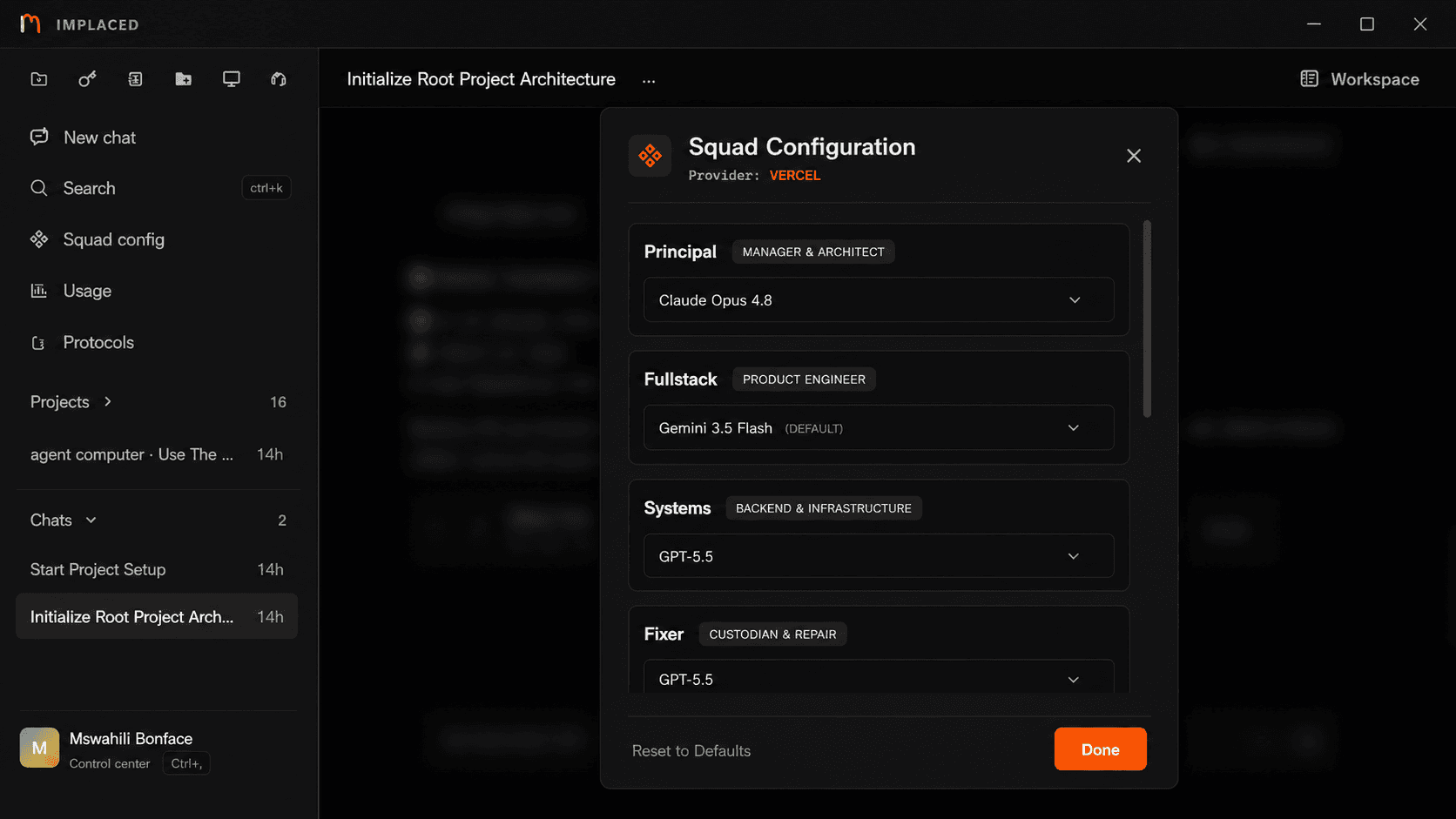
Model per Persona
A team can assign a stronger model to Principal, a faster model to Fullstack, a different route to Systems, and keep OSOps separate. The runtime treats the chosen model as part of the lane contract, not a hidden global default.
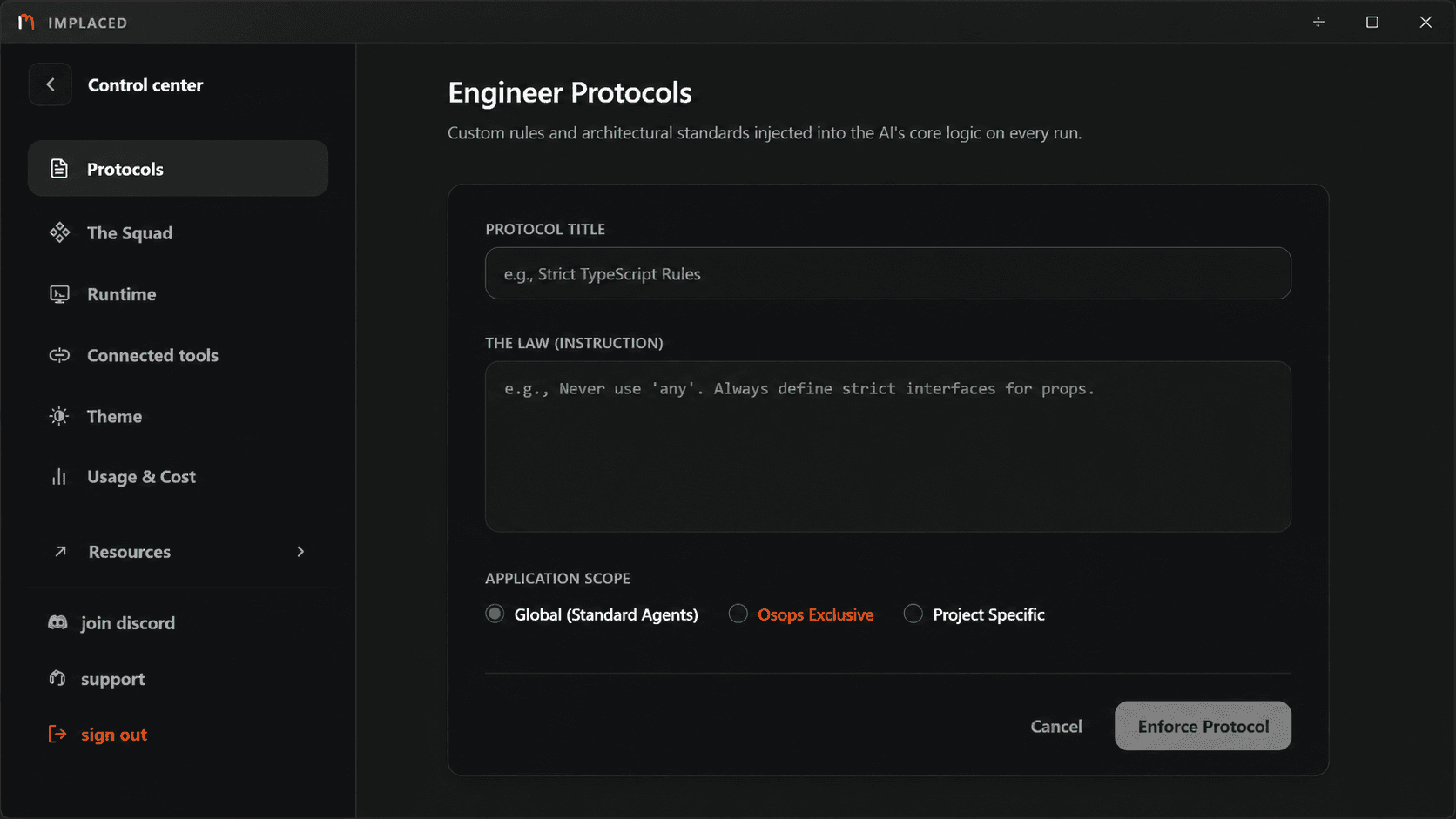
Rules at run time
Protocols are custom laws injected into the run: global standards, project-specific rules, or OSOps-only instructions. They let teams add architectural constraints without rewriting the product or training a new model.
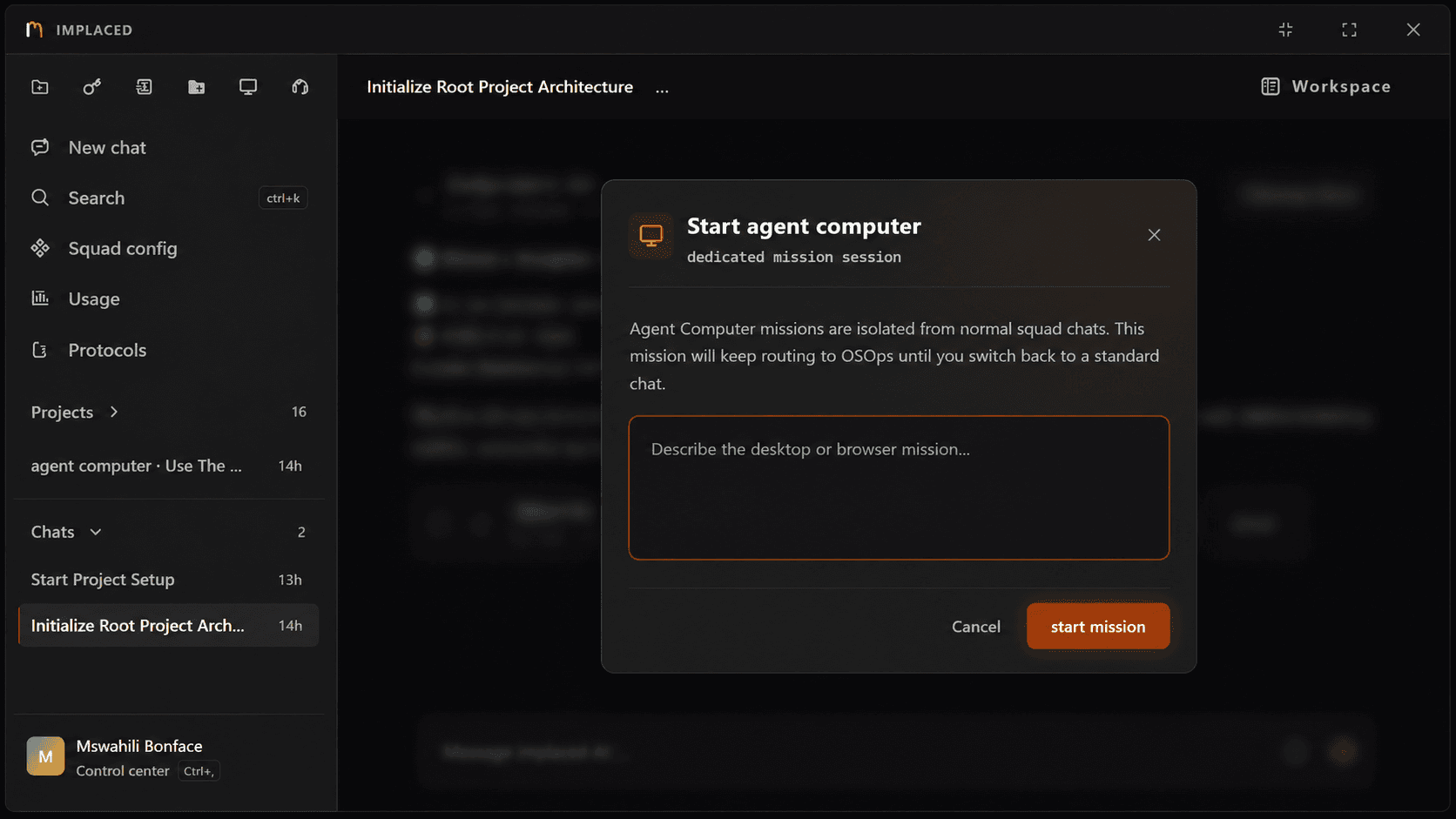
Dedicated runtime session
When a task needs a browser, an Electron app, or a desktop surface, Implaced starts a dedicated mission session. That keeps OSOps isolated from normal squad chats and keeps the operator loop visible.
How a run moves
Principal maps the project, task, current files, and constraints before routing work.
The correct lane takes over with role-specific tools and boundaries.
Repo search, terminal commands, browser proof, git receipts, security checks, or Agent Computer surfaces are selected by need.
Verifier or the owning lane produces evidence before a claim becomes complete.
Fixer, RepoOps, or the original owner repairs the exact failed slice without rewriting the mission.
Why this matters
Personas, protocols, model assignment, specialized tools, and Agent Computer sessions make the system explainable. Users can see what the runtime is doing, which lane is acting, and why a result should be trusted.